The ones reading this Blog, who are learning Japanese, surely know the 12 months in Japanese by now. They are very simple, since you just combine the numbers of 1 to 12 with month: 1月2月...12月.
Sure, but did you know the month have real names too? They are not used so much anymore, but it is interesting to know about them? Why? Because they tell you a lot about the culture. Take English or German months for example. Have you ever thought where they came from? No?
January: Janus, god of the doorway (Roman mythology)
February: februum, lat. purification (during Roman times, there was a purification ritual held on February 15th)
March: Martius was the first month of the year in Roman times, it was named after the god of war Mars
April: Aprilis was the second month of the year in Roman times. The etymology is uncertain, but maybe derived from lat. aperire = to open up (like the flowers in April)
May: also uncertain but probably based on the Greek fertility goddess Maia (lat. Bona Dea)
June: Juno, the wife of Jupiter head of the Roman pantheon
July: named after Julius Caesar (earlier name was Quintilis, the fifth month of the Roman calender)
August: named after Caesars successor Augustus (earlier name was Sextilis, sixth month of the Roman calender)
September: from lat. septimus = seven (seventh month in the Roman calender)
October: from lat. octo = eight (eighth month in the Roman calender)
November: from lat. novem = nine (ninth month in the Roman calender)
December: frpm lat. decem = ten (tenth month in the Roman calender)
Well now you know. Interesting isn't it, although it sure gets boring after Augustus. Still interesting to see that also the Romans partly used an easy intuitive number system for the month, same as Japanese today. But let's now have a look at the Japanese names, shall we?
1月 睦月 mutsuki affection month
2月 如月 kisaragi changing clothes
3月 弥生 yayoi new life; the beginning of spring
4月 卯月 udsuki a type of flower blooming in April
5月 皐月 satsuki a type of flower blooming in May (alpine rose)
6月 水無月 kinatsuki month of water (無 is inserted for the な na particle of adjectives, so it does not mean month without water, but watery month)
7月 葉月 hadsuki book month
8月 文月 fudsuki leaf month
9月 長月 nagatsuki long month
10月 神無月 kannadsuki month of gods (無 has the same function as in 6月)
11月 霜月 shimotsuki frost month
12月 師走 shiwasu priests run (because they are very busy with all the year-end festivals)
I like how some of the names are both funny and practical. In February you change from winter clothes to spring clothes, so let's call the month: "changing clothes". Or even better December is "priests run", because everyday you can see them run around and make preparations for the year-end festivals.
So why in the world did I stumble across this, you may ask. The reason weighs only a couple of pounds and is very cute. My language exchange partner Nakamura-san became father a couple of weeks ago and he and his wife gave the little baby the name 皐月 Satsuki. Having a curious nature, I asked him what the name means and where it comes from. Well and this started us marveling about English, German (German months have the same origins) and Japanese months.
From the 12 traditional names for month, apparently both 皐月 Satsuki and 弥生 Yayoi are still used for girl names in Japan.
soon Satsuki-chan will be able to leave the hospital, and I am invited to see her :D
mika
Showing posts with label 日本語. Show all posts
Showing posts with label 日本語. Show all posts
Saturday, 7 June 2008

Friday, 28 March 2008
長寿祝い Special Birthdays For The Long Lived
Good Day!
Today I am telling you about a really nice little thing in the Japanese language. Once a person gets 60 years old, she/he is considered to have passed all aspects of life on earth once. This is because with 60 you will have experienced all possible combinations of the 10 干 calender signs with the 12 支 zodiac animals. So you count as experienced in life and bound to have gathered some wisdom, that is reason enough to start celebrating certain special birthdays for the long lived getting older than that.
Now the funny thing is, most of those special birthday consist of one Kanji with a certain meaning plus the Kanji for long life 寿 Ju, which curiously enough, you can also find in 寿司 Sushi. Not enough the first Kanji has usually a little Kanji game into it resembling both the age of the birthday and bearing a meaning at the same time.
The 60th birthday itself is celebrated with 還暦 KANREKI, which means just what I explained you above, the 10 干 calender sings and the 12 支 animal circles have been completed once in every possible combination.
Apart from this the birthday Kanji often has this little Kanji game into it, which I mentioned. For example the 77. birthday is called 喜寿 where 喜 KI means enjoy, like, love, joy. So 77 is a very joyful birthday. However the Kanji 喜 was written differently in the 平安時代 Heian Era (794 - 1192).
Back than it was written . 七 means seven, so the Kanji is written like three times seven. Now the Kanji 十 means ten and looks almost like seven. So with some imagination you can see 七十七 in the old version, which means 77. ^_^
Now for some quiz:
Yet another birthday is written 米寿 BEIJU. But at which age do you celebrate BEIJU? For what age does 米 BEI (rice) stand for?
The solution is written below in white color, so just mark the text with your mouse, when you are giving up.
For people not familiar with Japanese/Chinese Kanji, who want to do the Quiz too, here are the Kanji for the numbers from 1 to 100.
1:一 2:二 3:三 4:四 5:五 6:六 7:七 8:八 9:九 10:十 100:百
#######################################
#米 BEI (rice) when written fast and hurriedly looks like
#八
#十
#八
#and thus its the 88th birthday Kanji^_^
#######################################
And one more quiz, the other way round.
The 99th birthday is celebrated with 白寿 HAKUJU, where 白 HAKU means white. But why? The Kanji has no resemblance whatsoever to 99 九十九? Can you guess why 白 HAKU was chosen?
#######################################
#100 in Kanji is 百 HYAKU (100) and 1 is 一 ICHI (1).
#Now if you subtract 1 from 100, you of course get 99.
#So let's do it:
#百 - 一 = 白
#######################################
Here is a table I found with the rest of the special Birthday Kanji.
Some of them are really funny. And you see that they reach as far as 120 大還暦, which means you finished the cycle of life twice and are probably already considered a god or dead ^_^.
Today I am telling you about a really nice little thing in the Japanese language. Once a person gets 60 years old, she/he is considered to have passed all aspects of life on earth once. This is because with 60 you will have experienced all possible combinations of the 10 干 calender signs with the 12 支 zodiac animals. So you count as experienced in life and bound to have gathered some wisdom, that is reason enough to start celebrating certain special birthdays for the long lived getting older than that.
Now the funny thing is, most of those special birthday consist of one Kanji with a certain meaning plus the Kanji for long life 寿 Ju, which curiously enough, you can also find in 寿司 Sushi. Not enough the first Kanji has usually a little Kanji game into it resembling both the age of the birthday and bearing a meaning at the same time.
The 60th birthday itself is celebrated with 還暦 KANREKI, which means just what I explained you above, the 10 干 calender sings and the 12 支 animal circles have been completed once in every possible combination.
Apart from this the birthday Kanji often has this little Kanji game into it, which I mentioned. For example the 77. birthday is called 喜寿 where 喜 KI means enjoy, like, love, joy. So 77 is a very joyful birthday. However the Kanji 喜 was written differently in the 平安時代 Heian Era (794 - 1192).
Back than it was written
 . 七 means seven, so the Kanji is written like three times seven. Now the Kanji 十 means ten and looks almost like seven. So with some imagination you can see 七十七 in the old version, which means 77. ^_^
Now for some quiz:
Yet another birthday is written 米寿 BEIJU. But at which age do you celebrate BEIJU? For what age does 米 BEI (rice) stand for?
The solution is written below in white color, so just mark the text with your mouse, when you are giving up.
For people not familiar with Japanese/Chinese Kanji, who want to do the Quiz too, here are the Kanji for the numbers from 1 to 100.
1:一 2:二 3:三 4:四 5:五 6:六 7:七 8:八 9:九 10:十 100:百
#######################################
#米 BEI (rice) when written fast and hurriedly looks like
#八
#十
#八
#and thus its the 88th birthday Kanji^_^
#######################################
And one more quiz, the other way round.
The 99th birthday is celebrated with 白寿 HAKUJU, where 白 HAKU means white. But why? The Kanji has no resemblance whatsoever to 99 九十九? Can you guess why 白 HAKU was chosen?
#######################################
#100 in Kanji is 百 HYAKU (100) and 1 is 一 ICHI (1).
#Now if you subtract 1 from 100, you of course get 99.
#So let's do it:
#百 - 一 = 白
#######################################
Here is a table I found with the rest of the special Birthday Kanji.
Some of them are really funny. And you see that they reach as far as 120 大還暦, which means you finished the cycle of life twice and are probably already considered a god or dead ^_^.
| 満年齢 | 祝い行事 | 読み方 | 長寿祝い名の由来 | |
| 60歳 | 還暦 | かんれき | 十干十二支の暦では60年で一巡するとされ、61歳になって生まれ干支に環る(本卦環り=ほんけかえり)ことから。 | |
| 69歳 | 古希 | こき | 唐の詩人杜甫の漢詩「人生七十古希稀なリ」から採られた。 | |
| 76歳 | 喜寿 | きじゅ | 草書で書いた喜の字が七十七に読めることから。 | |
| 79歳 | 傘寿 | さんじゅ | 傘の略字が八十と読めることから。 | |
| 87歳 | 米寿 | べいじゅ | 米の字を分解すると、八十八と読めることから。 | |
| 89歳 | 卒寿 | そつじゅ | 卒の草書が九十と読めることから。 | |
| 98歳 | 白寿 | はくじゅ | 百から一を取ると白になることから。 | |
| 99歳 | 百賀 | ひゃくが ももが | 文字どおり100歳になったお祝い。 | |
| 百寿 | ひゃくじゅ ももじゅ | |||
| 上寿 | じょうじゅ | 60歳を下寿、80歳を中寿、100歳を上寿とするのもある。 | ||
| 紀寿 | きじゅ | 紀は一世紀のこと。 | ||
| 100歳 | 百一賀 | ひゃくいちが | 100歳以上は毎年百二賀・百三賀などとして祝う。 | |
| 108歳 | 茶寿 | ちゃじゅ | 茶の字を分解すると、十が二つと八十八になることから。 | |
| 109歳 | 珍寿 | ちんじゅ | 文字どおり珍しいことから。 | |
| 110歳 | 皇寿 | こうじゅ | 皇の字を分解すると、白(99)と十二になることから。 | |
| 120歳 | 大還暦 | だいかんれき | 二回目の還暦を迎えることから。 |
Wednesday, 5 December 2007
日本語授業 Japanese Lessons
As you might know I am taking Japanese lessons to improve my Japanese. For that I am very lucky to live in Atsugi, since the rich city offers free Japanese lessons almost everyday.
Atsugi is a rich city, because it gets a lot money/rent from the American military base on its territory. Therefore the city has a good 福利厚生 (well fare system) and a lot of things you can do for free or very cheap. Every citizen in the city is aware of the government having much money and therefore exert a certain pressure through expectation to the city government. :)
Anyway I wanted to talk about the Japanese lessons I am attending. While being financed by the city, the teachers themselves are ボランティア (borantia, volunteers).
All of them are therefore really nice, friendly and motivated. You have already seen/read Rumi-sensei in one of my previous posts. She often joins us on occasions and accompanied me to the Megadeth concert in Shibuya (see previous posts). Yet another sensei, Kaneko-sensei, offered to take my friend Manu to Kamakura, while he was here and while I had to work.
Currently I am attending two lessons a week on Wednesday and Thursday. The first class is a little secret, since it does not appear on the city information sheet about Japanese classes. The reason for that is, that both the room and the number of teacher is smaller than on the rest of the lessons. But this secret has been passed on from intern generation to intern generation, so that most lesson taking interns go on that day. But me and others also told friends, intending of to learn the language of this class, so that apart from interns, there are also a lot of other foreigners :)
Since this class is as said a bit smaller, the teachers surprised us last time with a Christmas party. They bought a lot of handicraft resources which allowed us to make Christmas Wreathes together. Of course we also had cookies tea and juice :) It was a wonderful idea, I loved to create my own Christmas Wreath and the kindness of our teachers really touched my heart. Here are some pictures from that day.

our kind teachers, which had the Christmas Wreath handcrafting idea
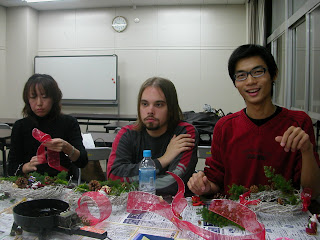
from left to right: rumi-sensei, Ryan (Texas, USA), Hong Lun (Singapore)

Noppoi from Thailand

and me. I named my wreath: "Santa lost in the woods"
When we proceed one day we are at Thursday's class. It is in a bigger room and a lot more students attend. While Wednesday's class is fit for what the students want to learn, Thursday's class has a fixed program and groups sorted by skill level. Having had a top Japanese education in my University in Germany (Univeristy of Erlangen-Nuernberg), I am in the top class. However even the top class' level is still a little bit easy. Yet we cannot raise the level too much, since nice people like guitar hero Giovanni from Colombia couldn't follow the lesson like that. So the teachers thought of a nice compromise and let the top level group focus on conversation. Like that everybody can talk up to his own knowledge. And expressing oneself in a way that everyone in the group can understand you, is quite a challenging task. Also conversation is my biggest weakness in Japanese up to day :)
While other students and I were preparing for the JLPT, Wednesday class' teachers gave us special JLPT lessons, being able to adapt to students desires, on Thursdays however, having a fixed schedule, they couldn't. So one of Thursday's class teachers, 野村先生 Nomura-sensei offered me free private lessons at her home in the outskirts of Atsugi one day. I was really lucky!
Nomura-sensei is a retired teacher and married to a wonderful husband for a long time. However they are not able to get children, which is why they don't have any. So after retiring, they decided to teach young people for free in their home to get in touch with the young generations and teach them a bit of their knowledge :).
Apart from that Nomura-sensei's husband, Akira-sensei, has breast cancer and cannot leave the house. They are not able to heal the cancer and they can't tell him, how long he has left to live.
This is why Nomura-sensei decided to bring students to their home. It is the only way for Akira-sensei to see other people and have some conversation.
It was a bit hard for me at first, but soon I realized that it is just the best we can do, giving Akira-sensei a nice time, conversing about interesting topics and giving him the chancer to put his knowledge and intelligence to use. And both of them are so incredible warm and friendly! They really touched my heart, every time I visited them. Nomura-senei would usually cook for the three of us, always being careful to not include animals on my behalf =D We would have some tea and cookies, cake, Japanese sweets in the afternoon and thus spend a lot of days studying hard, but also in merry conversation.
I am really grateful that they gave me this wonderful time, and I hope they enjoyed our time as much as I did.
Now that the JLPT is over, we decided to give it a break until January having met once or even twice a week before the test. In January we will continue the lessons, but in exchange I promised to try and teach them a little bit of English. Their English is already very good and they have a huge vocabulary, which is quite impressive for their age! So I will see what I can do :)

Nomura-sensei and Akiko-sensei in fron of Mt. Fuji
Now you know a bit about "out of school" Japanese lessons in Japan, and culture, knowledge and kindness exchange between Japanese people and foreigners =)
mika
P.S. Hong Lun and I decided to traditionally hang our Christmas Wreaths outside our apartment doors. Here's how they look like ^^

Hong Lun's Santa looking around searching his sleigh

and my scared and lost one
Atsugi is a rich city, because it gets a lot money/rent from the American military base on its territory. Therefore the city has a good 福利厚生 (well fare system) and a lot of things you can do for free or very cheap. Every citizen in the city is aware of the government having much money and therefore exert a certain pressure through expectation to the city government. :)
Anyway I wanted to talk about the Japanese lessons I am attending. While being financed by the city, the teachers themselves are ボランティア (borantia, volunteers).
All of them are therefore really nice, friendly and motivated. You have already seen/read Rumi-sensei in one of my previous posts. She often joins us on occasions and accompanied me to the Megadeth concert in Shibuya (see previous posts). Yet another sensei, Kaneko-sensei, offered to take my friend Manu to Kamakura, while he was here and while I had to work.
Currently I am attending two lessons a week on Wednesday and Thursday. The first class is a little secret, since it does not appear on the city information sheet about Japanese classes. The reason for that is, that both the room and the number of teacher is smaller than on the rest of the lessons. But this secret has been passed on from intern generation to intern generation, so that most lesson taking interns go on that day. But me and others also told friends, intending of to learn the language of this class, so that apart from interns, there are also a lot of other foreigners :)
Since this class is as said a bit smaller, the teachers surprised us last time with a Christmas party. They bought a lot of handicraft resources which allowed us to make Christmas Wreathes together. Of course we also had cookies tea and juice :) It was a wonderful idea, I loved to create my own Christmas Wreath and the kindness of our teachers really touched my heart. Here are some pictures from that day.

our kind teachers, which had the Christmas Wreath handcrafting idea

from left to right: rumi-sensei, Ryan (Texas, USA), Hong Lun (Singapore)

Noppoi from Thailand

and me. I named my wreath: "Santa lost in the woods"
When we proceed one day we are at Thursday's class. It is in a bigger room and a lot more students attend. While Wednesday's class is fit for what the students want to learn, Thursday's class has a fixed program and groups sorted by skill level. Having had a top Japanese education in my University in Germany (Univeristy of Erlangen-Nuernberg), I am in the top class. However even the top class' level is still a little bit easy. Yet we cannot raise the level too much, since nice people like guitar hero Giovanni from Colombia couldn't follow the lesson like that. So the teachers thought of a nice compromise and let the top level group focus on conversation. Like that everybody can talk up to his own knowledge. And expressing oneself in a way that everyone in the group can understand you, is quite a challenging task. Also conversation is my biggest weakness in Japanese up to day :)
While other students and I were preparing for the JLPT, Wednesday class' teachers gave us special JLPT lessons, being able to adapt to students desires, on Thursdays however, having a fixed schedule, they couldn't. So one of Thursday's class teachers, 野村先生 Nomura-sensei offered me free private lessons at her home in the outskirts of Atsugi one day. I was really lucky!
Nomura-sensei is a retired teacher and married to a wonderful husband for a long time. However they are not able to get children, which is why they don't have any. So after retiring, they decided to teach young people for free in their home to get in touch with the young generations and teach them a bit of their knowledge :).
Apart from that Nomura-sensei's husband, Akira-sensei, has breast cancer and cannot leave the house. They are not able to heal the cancer and they can't tell him, how long he has left to live.
This is why Nomura-sensei decided to bring students to their home. It is the only way for Akira-sensei to see other people and have some conversation.
It was a bit hard for me at first, but soon I realized that it is just the best we can do, giving Akira-sensei a nice time, conversing about interesting topics and giving him the chancer to put his knowledge and intelligence to use. And both of them are so incredible warm and friendly! They really touched my heart, every time I visited them. Nomura-senei would usually cook for the three of us, always being careful to not include animals on my behalf =D We would have some tea and cookies, cake, Japanese sweets in the afternoon and thus spend a lot of days studying hard, but also in merry conversation.
I am really grateful that they gave me this wonderful time, and I hope they enjoyed our time as much as I did.
Now that the JLPT is over, we decided to give it a break until January having met once or even twice a week before the test. In January we will continue the lessons, but in exchange I promised to try and teach them a little bit of English. Their English is already very good and they have a huge vocabulary, which is quite impressive for their age! So I will see what I can do :)

Nomura-sensei and Akiko-sensei in fron of Mt. Fuji
Now you know a bit about "out of school" Japanese lessons in Japan, and culture, knowledge and kindness exchange between Japanese people and foreigners =)
mika
P.S. Hong Lun and I decided to traditionally hang our Christmas Wreaths outside our apartment doors. Here's how they look like ^^

Hong Lun's Santa looking around searching his sleigh

and my scared and lost one
Subscribe to:
Posts (Atom)