祭さん The Festival Guy
This week I met a Japanese guy at work, who loves festival really much. His name is Kinya and he works in the same building (the A X T Main Tower), but in a different floor. He asked the new and old interns, if they would join up with him for two festivals this Saturday in 東京 浅草 and 六本木 (Tokyo Asakusa and Roppongi). Since I had no plans for this weekend yet, I thought it of a good chance to get more into Japanese culture and hooked up. We were complete with Boy (same floor as I, but north side) and a Japanese friend of his.
Since Boy is already fluent in Japanese, it also was my least English spoken trip so far ^=^. I think I learned a lot Japanese that day.
The two festivals he spoke of were not that 日本の伝統な祭 Japanese traditional festivals as I first hoped. The first was the 浅草 annually SAMBA Carnival and the other a 祭 in 六本木, which was a kind of international culture and food festival organized both by the city and the embassies in Tokyo. On second thought I decided that learning about Japanese modern cultural festivals and its view on international culture would be just as interesting as the traditional ones. And I was not mistaken!
Last but not least, since I am from Germany and in Germany Carnival means Fasching and Fasching means to dress up with costumes, I had to stay true to my childhood programming and went to 東京 dressed up (see pictures). ;)
浅草 Asakusa

There we go, all dressed up and ready to go, I met with Boy his friend and Kinya-san at 本厚木 station and we boarded the first train to 新宿. From there you have to change the train line to 中央線 (Chuo Line) and then in お茶ノ水 (Ochanomizu, yeah that's right, there is a place in Tokyo called water for green tea) to the 銀座 地下鉄 (Ginza Subway). As you can see, it can be pretty difficult to get around in Tokyo, even to bigger and famous places like 浅草. The reason is that Tokyo is ruled by several independent train and subway and train companies, which all have their own territories just like the Mafia does. Therefore when you enter another territory you have to leave your previous means of transportation and pay protection money to the local TrainMafia for the next train/subway. ;p
Anyway we finally arrived in 浅草 way too early and had about 3 hours left, before the carnival would start. Therefore the others asked me: 浅草に行ったことがありますか。(Have you ever been to Asakusa before?). I had, but only because of changing the TrainMafia on our way to 日光 (Nikko). Therefore the others cheered: 浅草を案内しましょう。 (Let's show you Asakusa). And so they did. First they we went to some famous shopping road, which is called "shops under a roof" (and there was indeed a roof above the road, similar to the ones we had seen in 大阪 Osaka). The fried/baked sweets on this road were really 美味しい (tasty), you have to try them, we you are around 浅草. Apart from that the road is alas heavenly adjusted to foreign tourism, so that you will find mostly things not really Japanese. For example a store sold 温泉 (onsen, hot spring) cloths as real 着物 (kimono).
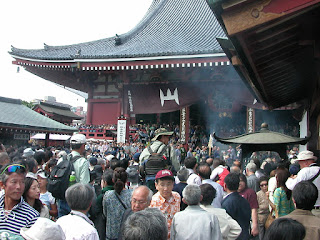
Afterwards we roamed through the city, entered red a famous 神社 (shrine) and walked through some really nice roads. In these roads you meet several 人力車 (Rikksha),
operated by muscular men offering you to take you around the city. In front of the shrine we entered is a well of 線香 (joss sticks), which, when you stick your head in, are said to make you bright. Next to it is another spring well with water, which when put onto your skin and gurgled in your mouth is said to make you healthy (you can find these two on several places in Japan). Apart from that there was also a famous temples with 5 stages, which is sold as a sweet in the road I mentioned before.
Still having some time left, we decided to go for lunch before the carnival starts. Kinya-san tried to figure out some Japanese food, which I have not tried yet and we ended up with お好み焼き (Okonomiyaki). This is a kind of food which is brought to you in a bowl. You first have to mix it thoroughly and then put it on a cooking plate, which happens to be your table and cook it similar to a pancake. That means you have to turn it around at the right time. You can eat it with some special kind of thick sauce, herbs and optional mayonnaise (I skipped the last one). It tastes really good and I surely will eat it again soon.

From left to right: Kinya, Boy, a strange time traveler, Boy's girlfriend (I forgot her name :()


shops under a roof

the famous 5 level temple


One of the biggest temples in 浅草, right at the end of the "shops under a roof"

Before you enter a Japanese temple you purify your hands and your mouth with water.


The joss sticks here are said to make you clever if you put your head into the smoke.

Japanese traditional cloths vs. European ones


This guy walks along 浅草 selling his own sweets. His cart looks very heavy.

A Japanese wedding with white Kimono is very rare

Some random guy made me do a Photo Shooting with him

Games for children

The woman has relatives in Germany and recognized my cloths

A very famous thief of the Edo period


お好み焼き Okonomiyaki

The view from the restaurant. The carnival had already started for us, when we were still eating.
浅草 SAMBA Carnival 2007

While we sat in the restaurant we already could see various small groups of carnival performers walk by the window to their starting points. Finishing right at 3 pm, we went to the big street, where it was going to happen. The carnival was partitioned into different groups from all around the country. Each group was huge, like 30 min of people passing our position on the street and had their own program and concepts. For example we saw colorful divers, clowns, inca/maya priestess and warriors, Irish elves, and many many more. Each group had live singers and musicians which played their instruments while walking. So the performers acted to some cool SAMBA live music. I have never seen a SAMBA carnival procession before, but I think I saw a Japanese interpretation of it today. That is one thing I like about Japan, instead of only copying things, they rather interpret it a new and show the result. Just like a song cover in music. There are few really good covers, and the few all show a very individual interpretation of the original song. What I also liked was that the procession did not only consist of women, which fit into some perverted kind of unreachable beauty ideal (of course such kind were present though), but any kind of women and any kind of men of any age and origin. That also included mothers and fathers performing together with their children, which was just too cute かわいい. =)


Parents performed together with their children

and their grandparents also did not stay at home


Their wagon looked really cool

Live music


cute mermaids

and divers searching for them


Japanese love baseball as much as Americans do


The clowns were really cool


looked a bit Bavarian


there were also handsome boys


and costumes influenced by Japanese tradition


I also liked those who performed as couples
六本木 麻布十番 納涼祭 (Roppongi Azabu Juban Summer Festival)

Kinya-san, being a great fan of festivals, is also very experienced about them (He got a high skill in festival lore). Therefore we in fact left before the carnival ended, but into the direction, were we still would be able to see performers already finished. The reason was, that when waiting for the end, it would have been near to impossible to get a train or subway or bus out of 浅草. So we might have missed some last performances, but were able to get to 六本木 which out much physical stress. This festival takes place in 麻布 (Azabu) right next to 六本木 (Roppongi) and included an International part. For example there was a place where each 大使館 (embassy) had their own stands for their country's cuisine and other famous items. I have included a map of this International Bazaar below.
Above you can see the logo of this year's festival. The girl and the owl. I love it really much and got myself a 扇子 (fan) with it on top. I can't imagine it was intentionally, but the picture so much reminds me of horror movies and the novel Alice in Wonderland (even more of the horror game with the same title). Last but not least it makes for a great Gothic motive.
Leaving the Bazaar we entered the rest of the festival, which was in fact all around the city. After a while we found a group of dancing people in a park. There was a little hill lit by lanterns, where a giant 太鼓 (Japanese Drum) was placed. One master, one man and two women took turns in drumming. It took an enormous amount of chakra, ah I mean strength to operate it. And the way they did it looked so magnificent. They looked sooo cool.
In the park itself circles of dancing people could be seen.
The innermost circle was of women (again of all age and gender), which knew the dance by heart. Those showed how to dance to the current music. Each music had there own way of dancing and was changed every now and then. All the other circles then tried to copy the dancing from the innermost one. Of course we immediately joined one of the circles and danced for about 5 or 6 songs. Some of the dances were easier to remember and some really hard, but it didn't matter how good you were, the feeling that was transmitted with everybody dancing together was just too strong to think about how good you were. And during all of this the giant 太鼓 kept its rhythm Boom Boom BoBoBoom Boom echoing over the whole park and somehow fitting to any kind of music played.
This kind of dancing is called 盆踊り (Bon Dance) and is a traditional Japanese way of celebrating. Many 祭り during the お盆 (O-Bon) time include this dance.
I think this was the part of the day I enjoyed most.
dancing for love and peace
mika
リンク Links
Samba CarnivalSummer Festival写真 Photos


The international Bazaar with food and other stuff from countries, which happen to have an embassy in Tokyo

The festival was crowded just like any other Japanese festival

Some of the temples had special performances like this group which made wonderful "temple" music with their instruments.

The festival had a stage where musicians and singers performed


盆踊り The Bon Dance


The 太鼓 (Japanese Drum) on the hill