Showing posts with label yoshida shouin. Show all posts

Tuesday, 22 July 2008

萩 Hagi

As promised yesterday (http://dwellingindreams.blogspot.com/2008/07/yamaguchi.html) Kimura-san picked me up in front of the university gate and drove me all the way to Hagi. On the way we talked more about the teachings of 吉田松陰 Yoshida Shouin, Buddhism and Philosophy. Japanese people don't really follow the teachings of Buddhism anymore or have any more interest in it than performing meaningless rites and festivals. They also lack the idealism that drove the 志士 (shishi, rebelling samurai driven by their ideals of a better world, where everyone would be equal). We were both happy to visit a town that produced men, that had all that and revolutionized Japan entirely...

萩 Hagi


Hagi is a really small town and its incredible to believe that not only was this the political center of the Choushu Province, but also the place were the revolution started, the place were Yoshida Shouin was born and taught, the place were most of the first Japanese politicians in the Meiji Era including the first Japanese Prime Minister came from.

Apart from its heavy history, the town is simply beautiful. Not a lot has changed since the 19th century and most parts of the city look just like back then. The inhabitants of Hagi are very eager to preserve both the look, as well as the history of Hagi and therefore started a guide organization, that takes care of the buildings and offers free guides and explanations throughout the city. Kimura-san knows such a guide personally and asked her, if she could show us around. So I ended up with two guides and many more local guides, my journey to Hagi was really blessed.


松蔭神社 Shouin Shrine


Our first stop was at Shouin Shrine, a shrine entirely dedicated to this remarkable man Yoshida Shouin. The shrine was built around the house, where he taught, inspired and inflamed the 志士 Shishi that carried on his word and ideals throughout Japan. It is incredible to see how tiny the house is. Also the same house was his prison, when he was first punished for improper teachings from the Shogunate. At this time his only outlet were books he got from oversea, which he studied eagerly.


in here Yoshida Shouin teached his wisdom


and in this small chamber he was confined


伊藤博文旧宅地 Old Residence of Ito Hirobumi


image from Wikipedia

Ito Hirobumi was the first prime minister of Japan. In his Youth he was a student of Yoshida Shouin and inspired by his visions. He joined the 尊皇攘夷 Sonnou Joui a league to restore the Tenno in power and expel foreigners from Japan. However he soon realized that Japan is lost without foreign knowledge and relations as Yoshida Shouin predicted and decided to secretly slip out of the country and study western science in London.


長州五傑 Choushu Five


All together five clever and courages students were chosen for the trip to London. They were called 長州五傑 Choushu Five. At this time the 鎖国 Sakoku (closed country) was still active and thus leaving the country was a heavy crime punished by death penalty (切腹 Seppuku). Still Ito Hirobumi, Inoue Kaoru, Yamao Yozo, Endo Kinsuke and Nomura Yakichi secretly set out on a ship from Yokohama going to Shanghai and from there to London. All of them studied different fields of western science and returned unharmed to Japan.

The five of them brought a gigantic leap to the science state of Japan and most formed important statesman, foremost Ito Hirobumi as the first Prime Minister of Japan. It must be fantastic to secretly study in a foreign country for the revolution in your own one, I admire and envy those five students!

Inside his house you can find tables with photo albums from the 幕末時代 (Overthrowing Of The Shogunate Period) and the beginning of the 明治時代 (Meiji Period). Also this being his residence, when he already was appointed prime minister, shows how simple the first prime minister chose to live.


photo albums of the time before and after the revolution

吉田松陰誕生地 Birth Place Of Yoshida Shouin


Yoshida Shouin was also born in Hagi and his family rests here. So our next stop was a little hill outside the town perimeters where Shouin grew up peacefully in a tiny house with a large family. The area is really beautiful and you have a good view over the town from the Shouin house. The house no longer stands and only its perimeters are marked. But the graves of his family still stand, and a statue of Yoshida has been placed next to them. The statue is looking at the ocean seeing into the future, bringing the western world into Japan.


the outlines of the Shouin Family House


state of Yoshida Shouin


here the Shouin family is burried


萩城城下町 Hagi Castle Town
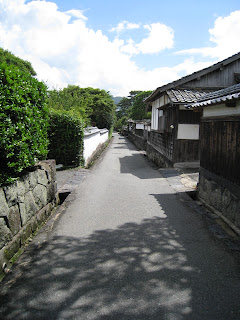


The urban area close to the castle remains relatively intact and offers wonderful aspects into how Japan looked 200 years ago. Many of the old Samurai residences are now open for visits and contain one of the afore mentioned free volunteer guides inside, others have been transformed into (also free) museums for local art.


The small valleys and distinctive houses and high walls are really eye catching, but they also served a purpose. The outline of the Castle Town was constructed to easily repel enemy attacks. For that for example the town contains many 怪曲がり (kaimagari = tricky corners) small alleys surrounded by high walls leading to a key like opening. A enemy approach from the alley can easily be ambushed from both sides (above the walls) and blocked at the key position.


怪曲がり kaimagari a trickery corner


木戸孝允 Takayoshi Kido


image from Wikipedia

Next we visited the residence of Takayoshi Kido, one of Yoshida Shouin's students, who became a leader of the Meiji Restoration. In his home there is much to discover if you ask one of the nice volunteer guides to show you around. For examples the outer planks around the garden are one of the famous "singing planks", natural wooden planks that make it impossible to walk over them without producing loud sound. Another example is a light show created below the ceiling. There you can find carved wood the produces wonderful shadow plays, when a fire is lit in the room.


to get into the house from these gardens, you have to walk over "singing planks"


this carving produced wonderful shadow plays, when a fire is lit


Kido's house is also an example for a house being used as museum. Inside you can find modern screaming sculptures made by Korean students in Yamaguchi Prefecture.


萩城跡 Hagi Castle Ruins


After starting the revolution, going through several wars and civil wars Choshu and Hagi could no longer afford to sustain a castle. That is why only ruins remain of the castle today. However having seen enough castles on my stay in Japan, seeing the ruins is actually nice for a change.


Also the area around the castle now is a really nice park and from the remaining castle walls you can enjoy a wonderful view over the sea, which inspired so many men in this city...


the sea


Kimura-san


mika


萩博物館 Hagi Museum


After we enjoyed some buffet with vegetables grown by farmers in Hagi, we continued to Hagi Museum. The museum is big and you can find many things related to local festivals and flora and fauna. However we were most interested in history and went straight to the history section (Again the museum is also free of charge).


高杉晋作 Takasugi Shinsaku


The historic part mainly deals with 高杉 晋作 Takasugi Shinsaku, the hero of Choshu Province. Born in Hagi he was one of the most passion burning students of Yoshida Shouin and soon became his favorite student. Later he tried to help Yoshida to get on board the 黒船 Kurofune (Pery's black ships) and tried to free him later, when he was imprisoned.


from left to right: Tatasugi Shinsaku, Yoshida Shouin, Kuzaka Genzui

Later he visited Shanghai to investigate on the rumors that western powers had turned the gigantic Chinese Empire into a mere colony of slaves. His visit was during the Taiping Rebellion and he witnessed the devastating effects of western power and the state life in China had degraded to. Upon his return he passionately joined the 尊皇攘夷 Sonnou Joui (league to restore the Tenno in power and to expel western occupation from Japan) and became, despite his young age, the most influential military leader in Choshu Province attracting people even from other provinces to join him.

His military rule proofed very successful. Following ideals of Yoshida Shouin he treated people equally independent of their society class and upcoming and therefore formed a militia consisting of all the people of Choshu, not only only of Samurai. Later he formed an elite military unit which he called 奇兵隊 Kiheitai. Its consisted of about 300 men, of whom no more than half were Samurai and the rest ordinary people inspired by his charisma and ideals.

After the first attack of Choshu Province against Kyoto (御門事変 Gomon incident) failed, Choshu Province leaders temporarily had to imprission him not to interfere in national politics.

However only a little later when Choshu's main port 下関 Shimonoseki bombarded western war ships, an invasion of four western powers: France, England, Dutch and American ships destroyed Shimonoseki and invaded Choshu. This invasion proofed even the most stubborn leaders of Choshu that the Japanese army at its current state is no match for western powers. Seeing their defeat they released Takasugi, entrusted him the prime military rule as well as the peace negotiations with all four western powers.

His victory however was again short lived when the Tokugawa Shogunate started a punitive expedition against Choshu as revenge for the Gomon incident in Kyoto. Takasugi had to flee the province together with later prominent figures like the first Prime Minister Ito Hirobumi.

When the expedition ended, he returned to a defeated Choshu again loyal to the Shogunate. He immediately attacked the conservative forces of Choshu and started the Choshu Civil War. His 奇兵隊 Kiheitai and military tactics proofed far superior than the traditional samurai way of fighting ans he had an easy victory. However Choshu Province was severely weakened after the Civil War.

When the Shogunate saw the end of the Civil War in favor of the 尊皇攘夷 Sono Joui they decided to launch a second punitive attack against Choshu and asked the loyal 薩摩藩 Satsuma Province, who helped fighting Choshu in the Gomon Incident to lead it. However 土佐脱藩者 坂本竜馬 Sakamoto Ryouma, who fled his home province (a crime punished with 切腹 seppuku) had good relations both to Yoshida Sounin's students Takasugi and
中岡 慎太郎 Nakaoka Shintaro, as well as to Satsuma warlord 西郷 隆盛 Saigo Takamori (the last Samurai) and was after much effort able to form an alliance between both parties who were archenemies and hated each other to the core to this day. The alliance was called 薩長同盟 Sacchou Alliance. This alliance would eventually proof strong enough to lead the Meiji Revolution to a success.


image from Wikipedia

the second master mind or revolutionizing Choshu: 中岡 慎太郎 Nakaoka Shintaro

Alas Takasugi Shinsaku never saw the fruits of his labor. He suffered his whole live under tuberculosis and died only one year before the Shogunate was overthrown. It can clearly been said that without this man, the revolution never would have happened...

When his tuberculosis took the upper hand over his health, he appointed one of his most trusted disciples 山縣 有朋 Yamagata Aritomo as his successor in leading the 奇兵隊 Kiheitai. The same Yamagata Aritomo would become the field marshal of the Japanese army and twice Prime Minister of the new Meiji Japan.


image from Wikipedia

山縣有朋 Yamagata Aritomo


Yoshida Shouin Museum


At the highway border to Hagi on our way back we crossed the Yoshida Shouin Museum, that had opened recently. It contains a recreation of Shouin's teaching room made a life with figures.


As for afore mentioned Sakamoto Ryouma, this guy has become my personal hero in the Japanese Revolution and we will learn more about him on my next stop: 長崎 Nagasaki...

mika

Monday, 21 July 2008

山口 Yamaguchi

My journey westwards continued to the end of 本州 Honshu, Japan's main island, where you will find the prefecture and city of 山口 Yamaguchi. I choose to mak a stop here, because one of my friends and university colleagues from Erlangen, Germany is doing a exchange term at Yamaguchi University.

山口 Yamaguchi


Yamaguchi connects 九州 Kyushu, Japan's west most island with 本州 Honshu, the main island. The city itself is small compared to cities like Okayama or Nara, but it has a charming atmosphere and there is a lot to see.

Lucky for me Andy offered me to guide me around the city, show me some interesting places and tell me their stories :) We started at ...

湯田温泉 Yuda Onsen


The university is not in the center of the city, but in a small town 5 kilometers away called Yuda Onsen (onsen = hot spa). There is a legend about Yuda Onsen, that says some monks saw a white fox taking a bath and curing his wounds there. The Onsen seemed to have healing powers and ever since people from all over the country streamed to Yuda Onsen to cure wounds of diseases.


Therefore the symbol of Yuda Onsen is the white fox, and he is towering over the town, right next to the station.


ザビエル記念聖堂 St. Xavier's Memorial Church


St. Xavier was the co-funder of the Jesuit order and the must successful Christian missionary since the days of St. Paul. He visited Japan and established roots for a Christian community, especially in Yamaguchi. Wikipedia says:


In December 1547, in Malacca, Francis Xavier met a Japanese nobleman from Kagoshima named Anjiro. Anjiro had heard from Francis in 1545 and had travelled from Kagoshima to Malacca with the purpose of meeting him. Having been charged with murder, Anjiro fled Japan. He poured his heart out to Francis Xavier, telling him about his former life and the customs and culture of his beloved homeland. Anjiro was a samurai and as such provided Xavier with a skilled mediator and translator for the mission to Japan that now seemed much closer to reality. “I asked [Anjiro] whether the Japanese would become Christians if I went with him to this country, and he replied that they would not do so immediately, but would first ask me many questions and see what I knew. Above all, they would want to see whether my life corresponded with my teaching."

He returned to India in January 1548. The next 15 months were occupied with various journeys and administrative measures in India. Then due to displeasure at what he considered un-Christian life and manners on the part of the Portuguese which impeded missionary work, he travelled from the South into East Asia. He left Goa on April 15, 1549, stopped at Malacca and visited Canton. He was accompanied by Anjiro, two other Japanese men, the father Cosme de Torres and Brother João Fernandes. He had taken with him presents for the "King of Japan" since he was intending to introduce himself as the Apostolic Nuncio.

Xavier reached Japan on July 27, 1549, but it was not until August 15 that he went ashore at Kagoshima, the principal port of the province of Satsuma on the island of Kyushu. He was received in a friendly manner and was hosted by Anjiro's family until October 1550. From October to December 1550, he resided in Yamaguchi. Shortly before Christmas, he left for Kyoto but failed to meet with the Emperor. He returned to Yamaguchi in March 1551 where he was permitted to preach by the daimyo of the province. However, lacking fluency in the Japanese language, he had to limit himself to reading aloud the translation of a catechism.

Xavier was welcomed by the Shingon monks since he used the word Dainichi for the Christian God. As Xavier learned more about the religious nuances of the word, he changed to Deusu from the Latin and Portuguese Deus. The monks also realized that Xavier was preaching a rival religion.

With the passage of time, his sojourn in Japan can be considered fruitful as attested by congregations established in Hirado, Yamaguchi and Bungo. Xavier worked for more than two years in Japan and saw his successor-Jesuits established. He then decided to return to India.


He established a church in Yamaguchi, which became the center of Christian life in the town. However under mysterious circumstances the church burned down to the grounds with the fire watch being no 5 minutes away. People say someone even called the fire watch, seeing smoke coming out of the church, and the fire fighters set out, but returned without extinguishing any fire. When they returned to the church later, that fire was so big, that the church could not be rescued any more.


Later when the economy was rising and Yamaguchi had a lot of money, the administration decided to built a memorial church for St. Xavier at the same spot where the old church has stood.


一の坂川 Ichinosaka-gawa River


Next Andy brought me to the river side of Ichinosaka river, where we enjoyed some cool drinks and cooled down from the hot day. Watching the beautiful river, he told me that in early summer a lot of fireflies can be seen along the river. And the people here like them so much that they made a festival in honor of the fireflies, the 蛍祭り Hotaru Matsuri (firefly festival). Alas fireflies only gather here for mating, which does not take longer than one or two weeks. But they return every year like fished returning to their birth waters.


I imagined seeing fireflies dancing on the water. It must be wonderful festival, with everyone marveling at those little insects and the moon reflected in the water below.


幽霊の神社 The Ghost Shrine


It isn't really called Ghost Shrine, but Andy gave it this nick name, because it sure looks like a Ghost Shrine, and the absence of people undermine this atmosphere. It looks kind of abandoned and yet it isn't, like as the ghosts of the former priests return every night and hold their services here... creepy


瑠璃光寺 Rurikōji Temple


Next Andy showed me his place for meditation and contemplation. He always goes here in times when he needs advice or a problem to overcome. But also when the stress of upcoming exams drain his energies.


Andreas' resting place

The temples lies quite high and you can enjoy a nice view over the city. The temple is quite famous for its ancient five storied wooden pagoda, which is standing since ages past. Despite his fame the temple is usually quite and peaceful and it feels refreshing walking around its borders.


the famous pagoda


temple main hall


sacrifices


Andreas


a pond with turtles


wheel of fortune


亀山公園 Kozan Park


Next to the temple itself you can find burial mounds of the Mori Lords who ruled over Yamaguchi in earlier times. There is a certain spot, which produces strange echoes if you clap your hands and stomp on the ground.


in Kozan park you can find a really beautiful graveyard too


burial mound of a Mori Clan Lord


Andreas showing me the clap stomping

This Kozan park next to the temple is also interesting for historical reasons. In a teahouse in the park Saigo Takamori from Satsuma Province and people from the northern Choushu province met secretly, claiming to practice the tea ceremony but in reality planning the overthrowing of the Tokugawa Shogunate and the upcoming successful revolution...


In this little tea house the revolution was plotted


維新百年紀年公園 Memorial Park Of The Revolution


And here we are, the memorial park of the revolution! It was constructed 100 years after the revolution had successfully overthrown the Tokugawa Shogunate and introduced new ideals of a society of equals open to the world. The class system was abolished and a elected government was slowly created and Japan was transformed into a modern state during the Meiji Period.


Yamaguchi Center For Arts And Media


One of the days I was strolling around Yamaguchi by myself looking for interesting things to catch my eye. And indeed the Center Of Arts And Media can hardly evade the eye, since it is so huge and long. I wondered what it would be and approached it slowly looking for an entrance.

Inside I realized it is a place for crazy modern art devised by local people. And best of all, you don't need to pat any entrance fee. The exhibition currently running was called "Ensembles": In the ground floor I suddenly found myself surrounded by old record players. When I looked closer I found some of them spinning, but when I approached they stopped. Then I heard a strange noise a
plastic clapping started. When I followed the noise I found one record player7s arm hitting against something fixed to the empty turntable. Before I could get a close look a loud noise started and the clapping stopped. The noise came from above, so I looked upwards and realized there are even more record players, I had previously assumed.


After this I relaxed for a while in a biotop between two walls of this strange building and read some in a book. After that I continued to the second floor and found myself in utter darkness. I had to think of the haunted house in Kurashiki and turned around in reflex to see if someone was standing behind me. There was nobody there. Where the haunted house was a narrow path, this place was a big open space, which made it harder to navigate, seeing nothing and having nothing to touch but the ground. When my eyes adjusted to the darkness, I realized there are people in the middle of the room playing instruments. But there was no music, only silent noise coming out of their instruments. When I got closer I realized the people were not real, they were only projections on a wall, but they certainly looked real. Even after I discovered the projectors, I wondered if some of them were still real.


video

What a great place! I love when you can experience art like this :)
Even more the hall also hosts a huge library, where you can even watch movies for free. I was tempted for a moment, but then decided to continue and explore the city.


the library

たこ橋 Octopus Bridge


Yamaguchi's biggest bridge is constructed quite complicated to offer everyone a convenient way of crossing without the use of traffic lights. Therefore now it looks like an octopus with many arms.

パーティー Parties


I was lucky to hit a good time for coming to Yamaguchi. On two of the days of my stay in Yamaguchi there were parties in the evening Andreas dragged me in joining. The first was a farewell party for another German exchange student from Marburg and the second a birthday party for a Brazilian guy, which was held all in South America style with people from Peru, Brazil and Mexico.

I learned a bit about South America and met some interesting guys, like a young Buddhist monk, who joined the birthday party, and who is planning to visit Brazil and help out at some Buddhist temples there. I was really surprised and questioned his story at first, but he was a real monk and his answers proved beyond doubt, that he is sincere in following the path of Buddhism. For example he told me for him, the meaning of life is to exist for others. He did not only refer to helping people, but his whole existence. Whenever he would talk or interact with someone or do something others might notice, in a way he will influence other people. So if he carefully chooses what to say and do, he can make a positive impact on people and help them grow.

国際公流会館 International Exchange Meeting Hall


This promising name simply refers to the dormitory for oversea students and nothing more. Here my friend Andreas has his room. Lucky for me, this place has a big common room with comfortable couches, were I slept three times.

There was a family of cockroaches living there: father cockroach, mother cockroach and two children. But surprisingly enough, after my experience of sleeping in a forest I was no longer afraid of cockroaches and had no problems of sinking into a comfortable sleep with the cockroach family crawling below me on the floor.

吉田松陰勉強会 Yoshida Shouin Learning Class


On my second day in Yamaguchi Andy and me met Kimura-san, the woman who sold him a flight ticket back to Germany, when we were buying some snacks for the farewell party mentioned above. She talked a little to us and was surprised that I was interested in the Meiji Revolution and the characters involved to make it happen. After hesitating a bit she told me that she was heading to a learning group, which in the spirit of Yoshida Shouin tries to see in to the future and find solutions for the problems of today. And if I would be interested, she would take me with her and we could join together. After hesitating for some moments too, I accepted and told Andy I would the join the party later.


Yoshida Shouin was an incredible genius who taught himself a lot and started teaching at the university at the age of 9. He had incredible foresight and predicted the course Japan would have to take not to become a resource colony to the Western World like Korea and China.

His intellect and charm attracted many students to his place in 萩 Hagi and following his teachings and spirit he succeeded in basically turning a whole province rebel. 長州藩 Choshu Province was the first to abolish the class system and teach and treat everyone equal. It became a place of idealism, dreams and free thinking. And because of that it had to be stopped and the Shogun sent a punishment force to destroy Choshu. At this time they also noticed that Yoshida Shouin, who was teaching in Edo in the mean time, tried to get aboard the famous 黒船 black ships of American Admiral Pery to establish direct relations and break the Shogun's law of isolation. For that he was imprisoned. However even at prison, he quickly established a school and continued teaching with his vast intellect and memory being all he needed. Eventually the Shogunate decided to execute him.

After that Choshu and the 志士 (shishi free thinkers and rebels to reform Japan) were weakened, but the spirits were unbroken. Especially two of his students continued his quest... but we will meet them and Yoshida Shouin in the next post...

The learning class' topic today was cell phones, and both me and Kimura-san were quite disappointed. It was about all the bad changed and dangers the cell phone brought to the Japanese society. I could agree on that, but Kimura-san told me usually they would talk about philosophical ideas, Buddhist teachings and how people might be able to change society and the world, like Yoshida Shouin did.

After the class before I went to the party, Kimura-san offered me to take me to 萩 Hagi, a own 40-50 kilometers away from Yamaguchi, which has been the intellectual center of Choshu Province. It was also the birthplace and teaching place of Yoshida Shouin, and in fact you can say that the Japanese Revolution started there. So like hell I wanted to go there, especially with a knowledgeable interesting guide striving in the spirits of this great forethinker.


Bonus Picture


it was a really hot day, even children needed to rest